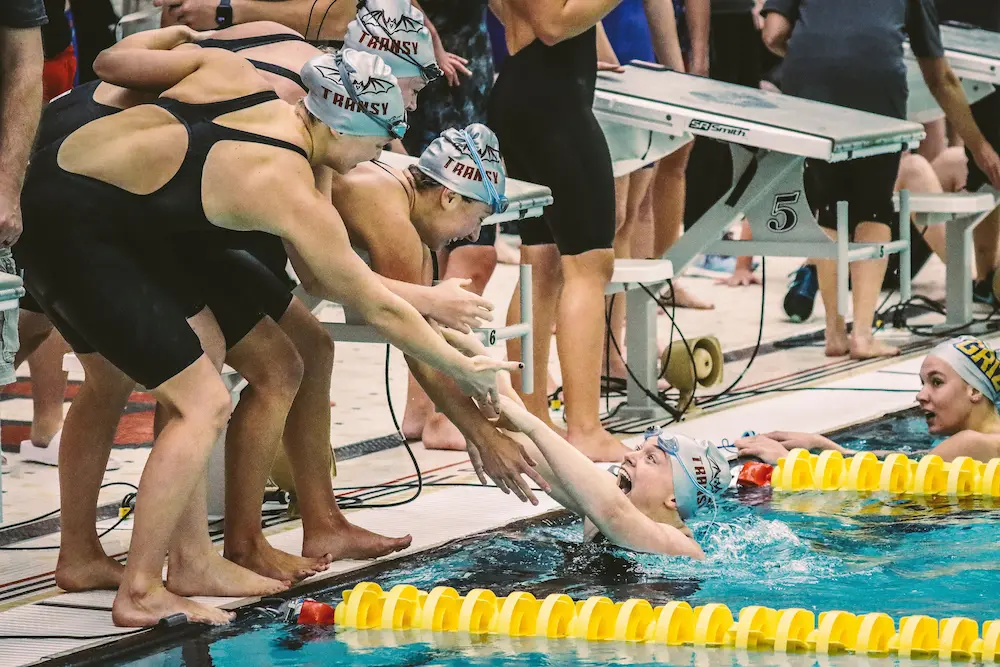
The first time a club emails you an entry form for something called a “Level 3 graded open meet with upper limit times”, it is reasonable to wonder whether you have joined a sport or a bureaucracy. In truth the system makes good sense once you see what each kind of competition is for — and knowing the difference will save your family wasted weekends and your swimmer wasted races. Here is the landscape, in plain English.
Club championships: the internal yardstick
Almost every club runs its own championships, usually annually, open only to its own members. Club champs are where many children race a “proper” gala for the first time, and they matter more than their cosiness suggests: they often decide squad moves, relay teams and club records, and many are licensed so that times count officially. Low pressure, high value — the ideal first taste of racing.
League galas: the team event
Inter-club leagues are the team sport hiding inside swimming: clubs field one or two swimmers per event across all age groups, points decide the match, and the last relay can decide the evening. Swimmers are selected by the club rather than entered by parents, and the racing is about the team, not the clock.
League galas are brilliant for atmosphere and racecraft — but note that they are not always licensed at a level where times count towards qualifying standards. Treat them as racing practice with team-mates cheering, and let the official times come from elsewhere.
Open meets: where the times come from
An open meet is a licensed competition hosted by a club but open to entries from any club — the workhorse of the competitive calendar. This is where personal bests are set and recorded in the British Swimming rankings database, and where county and regional qualifying times are chased (the mechanics of that chase are covered in how to qualify for the county championships).
Open meets are licensed at levels — Level 1 to Level 4 in the Swim England system — which govern the pool, the officials and which qualifying standards the times can be used for. Parents do not need to memorise the levels; you need only ask the coach one question: “Does this meet count for what we are aiming at?”
Most open meets also set entry times: standards your child must be faster than (lower limits) — and sometimes slower than (upper limits) — to enter each event. Which brings us to the most parent-friendly invention in the sport.
Development and graded meets: protected racing
A development meet (or graded meet) is an open meet with an upper speed limit: events are restricted to swimmers slower than a stated cut-off. The point is to give developing swimmers real racing — electronic timing, marshalled heats, medals — without lining them up against the county finalists. For a child new to competition, a well-chosen development meet is racing with the stabilisers on, and confidence built there carries straight into bigger pools.
Swim faster than the cut-off and your child collects the sport’s most backhanded compliment: the speeding ticket. The swim generally still stands as an official time, but it is excluded from the awards — because the swimmer was, delightfully, too fast for the event. Nobody should be upset by a speeding ticket. It is the meet telling you your swimmer has graduated.
Train with a specialist coach
One-to-one and squad coaching for triathletes, competitive swimmers and adult improvers across Hertfordshire and North London. Places are limited — check availability for your goal.
Check coaching availability →How to choose — and why not to over-enter
With club champs, leagues, developments and opens all on the calendar, the temptation is to enter everything. Resist it. Racing is a skill that needs practice, but improvement is built in training — and a swimmer who races every weekend trains properly on none of them. Over-entered swimmers get tired, stale and slower, in that order; it is one of the patterns behind the plateau we unpack in why has my child stopped dropping time?
A simple filter for any meet invitation:
- Purpose. What is this meet for — first-race experience, team racing, a licensed time, a qualifying attempt? If you cannot name the purpose, skip it.
- Level. Does your child fit the entry times comfortably — neither scrambling to make lower limits nor speeding-ticket fast for the grade?
- Timing. Does it land sensibly in the season — with training time between attempts at a target event, and not in the middle of a heavy school patch?
- The coach’s view. Clubs shape their meet calendar deliberately. When in doubt, the coach’s steer beats the balcony consensus.
One or two well-chosen meets in a racing block, each with a clear purpose, will do more for your swimmer than a gala every weekend — and will cost your family considerably fewer 6am alarms.
Making race day count
Whichever meet it is, the same quiet routines separate good race days from ragged ones: kit packed the night before, arrival in time for the full warm-up, something plain to eat between events, and a debrief on the way home that starts with what went well. Parents cannot swim the race, but they absolutely set the weather around it.
And if the races themselves keep exposing the same weakness — a slow start, a stroke that falls apart at pace, turns that lose a body length — that is not a reason to enter more meets; it is a reason to fix the fault. Our competitive swimming coaching works on exactly those race-exposed problems 1-to-1, alongside your child’s club programme — and for a target meet on a deadline, a short crash course block sharpens race skills in the weeks that matter. For the rest of the competitive landscape, start at the parent’s guide to competitive swimming in Hertfordshire.
Parent FAQs
What is the difference between a gala and an open meet?
Gala is the umbrella word for any swimming competition. An open meet is a specific kind: a licensed competition run by a host club that swimmers from any club can enter, usually with entry times, where results count towards official rankings and qualifying standards.
What is a speeding ticket at a swimming meet?
At graded or development meets with upper cut-off times, a swimmer who finishes faster than the cut-off gets a so-called speeding ticket: the swim usually still counts as an official time, but the swimmer is not eligible for the awards at that meet. It is a sign they have outgrown that grade of competition, not a punishment.
How many meets should my child enter in a season?
Fewer than most families expect. For a developing age-group swimmer, one competition roughly every three to six weeks in the racing part of the season is plenty — enough to practise racing and record times, while leaving space for the training that actually produces improvement. Follow the club’s guidance; coaches plan the calendar deliberately.