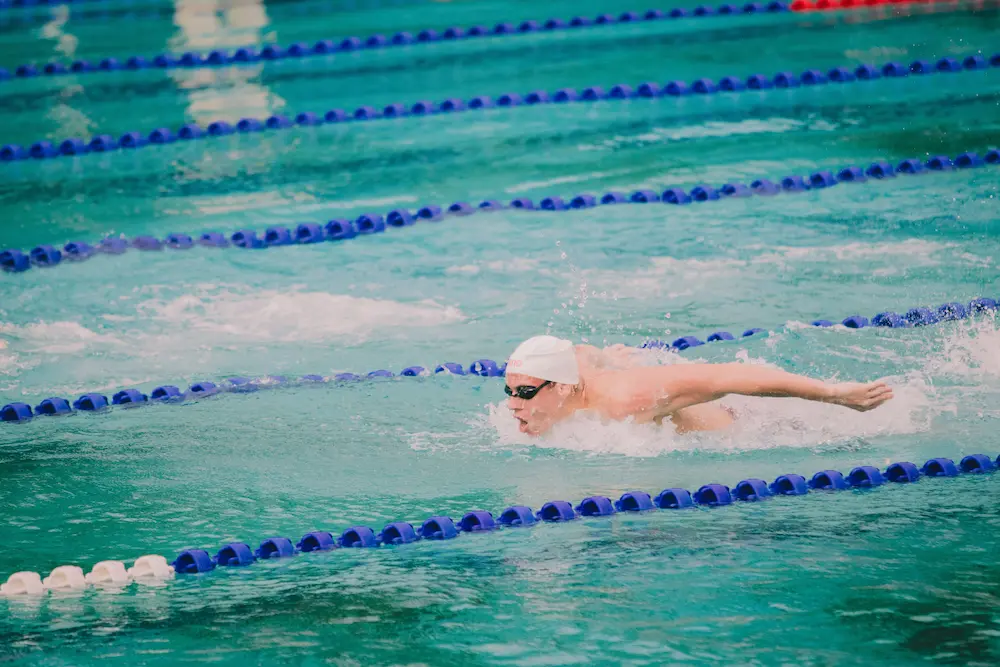
For the first few years of club swimming, improvement feels automatic: every gala brings a personal best, every certificate goes on the fridge, and the sport quietly teaches your child that work equals reward. Then, somewhere around eleven to fourteen for most swimmers, the escalator stops. Three galas in a row without a PB. Then a season. The swimmer is training as hard as ever — often harder — and the clock has simply stopped moving.
It is the question parents bring to us more than any other, and the first thing to say is reassuring: a plateau at this stage is close to universal, and it is very rarely about effort or attitude. But “normal” does not mean “ignore it”. Plateaus have causes, most of them technical, and the swimmers who break through are usually the ones whose specific cause gets found and fixed — rather than waited out or trained through.
First, rule out the boring explanations
Before anything technical: check the obvious. A swimmer who has recently moved up an age group is being measured against a harder standard — flat times can hide real progress against their new cohort, and the British Swimming rankings will show whether the trend is genuinely flat or just flat relative to expectation. A heavy exam term, a growth spurt in progress, patchy attendance after illness — any of these legitimately pauses progress, and patience is the correct coaching plan.
But when training has been consistent, the racing honest, and the times still stuck across multiple blocks — the cause is nearly always in the water. In our experience it is one of five things.
1. The stroke that only breaks at race pace
The most common culprit, and the most invisible from the balcony. Many club swimmers have a stroke that looks tidy in warm-up and holds together in aerobic sets — and quietly falls apart at race intensity: the catch slips, the stroke shortens, the head lifts, the kick fades. The swimmer is fit enough to go faster; the stroke cannot deliver the fitness at speed.
This is why “just train harder” fails as a plateau cure. Every hard set swum with a fault rehearses the fault. The fix is diagnostic: see precisely what breaks and when. It is exactly what video analysis exists for — filmed at race pace, above and below the surface, the moment of breakdown is usually visible within a handful of lengths, and suddenly everyone is fixing the actual problem instead of guessing at it.
2. Turns and underwaters: the free time nobody trains
In a 25m pool, a 100m race contains three turns; the underwater phase off each wall is the fastest a human moves in swimming. A swimmer who loses three tenths per wall to a slow rotation, a soft push-off or a short, weak underwater is giving away over a second per 100m — enough to explain an entire plateau on its own — while their stroke gets all the attention.
The happy flip side: walls are the fastest place to find time. Turns and underwaters respond quickly to focused technical work because they are short, repeatable skills rather than fitness projects.
3. Pacing: racing on enthusiasm
Watch the age-group heats at any meet: half the field swims the first length flat out and the last one in survival stroke. Pace judgement is a skill, and in big squad sessions it gets little individual attention. A 200m swimmer who learns merely to distribute the same fitness differently often finds two or three seconds without a single physical change.
Train with a specialist coach
One-to-one and squad coaching for triathletes, competitive swimmers and adult improvers across Hertfordshire and North London. Places are limited — check availability for your goal.
Check coaching availability →4. The arithmetic of a busy squad lane
Here is the structural cause, and it needs saying carefully, because club coaches are not the villains of this story. A squad coach with twenty-five or thirty swimmers in the water is doing an essential job — building fitness, consistency and race experience at a scale no individual coach can. What that format cannot do is arithmetic: thirty swimmers into one coach leaves a few minutes of genuinely individual attention per swimmer per week. A specific, personal fault — your child’s dropped elbow, your child’s late breath — can persist for years in a big lane, not because nobody cares, but because the format is built for the squad, not the fault.
That is precisely the gap supplementary 1-to-1 coaching fills, and why it works with the club rather than against it: the club provides volume and racing; the 1-to-1 sessions provide the twenty uninterrupted minutes on one fault that a squad session cannot.
5. Growth: the moving target
A swimmer who grows ten centimetres in a year is learning to swim in a new body — longer levers, different buoyancy, feet further from the head that coordinates them. Times routinely stall or slip during a growth spurt, and this plateau, uniquely, partially fixes itself. But “partially” matters: the new body needs its stroke deliberately refitted, not just time. Swimmers who do focused technique work through and after a growth spurt tend to come out the other side faster than their pre-spurt trajectory; swimmers who just keep grinding volume often lock in compensations.
What actually breaks a plateau
Notice what all five causes have in common: none of them is fixed by more metres. The pattern that works — the one we have watched break plateau after plateau in club swimmers across Hertfordshire — is short and specific:
- Diagnose — film the stroke at race pace and find the two or three faults that are actually costing time, rather than the ten that are merely visible.
- Isolate — fix them 1-to-1, where the set can slow down, repeat and rebuild around one swimmer, with re-filming to prove the change has held.
- Reintegrate — send the corrected stroke back into club training and racing, where the volume cements it.
That sequence — video analysis into 1-to-1 technical coaching into club racing — is the entire design of our 1-to-1 coaching alongside your child’s club. It typically takes a handful of sessions, not a second training life, because it is aimed at a diagnosis rather than at “improvement” in general.
A plateau, in the end, is not a verdict on your child’s potential. It is a message that the current inputs have done all they can — and an invitation to change the input, not to double it. (For where plateaus fit in the normal arc of a swimming childhood, see the age-group development pathway, and for the wider landscape, the parent’s guide to competitive swimming in Hertfordshire.)
Parent FAQs
How long is a normal plateau for a club swimmer?
A few months without a personal best is completely normal, particularly through a growth spurt or a heavy school term. A plateau worth investigating is one that persists across two or more racing blocks — six months to a year — despite consistent training and honest racing.
Will more training sessions fix a plateau?
Usually not, and sometimes the opposite. If the underlying cause is technical — a stroke that breaks down at race pace, slow turns, poor pacing — extra volume mostly rehearses the fault more often. Diagnose first, then decide whether the answer is more work or different work.
Is it just a growth spurt?
Quite possibly — rapid growth genuinely disrupts coordination, and times often stall or slip while a swimmer relearns their own body. But growth-spurt plateaus resolve with patience plus technique work; if the times are still stuck a term after the growth has settled, something technical usually needs attention.