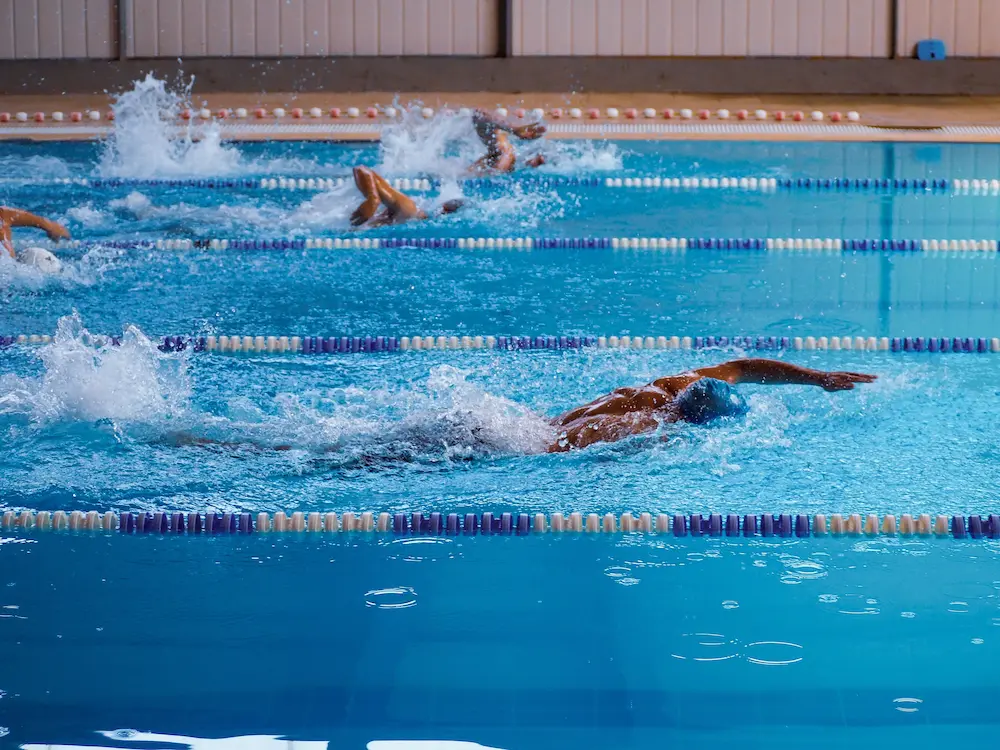
Your child joined the local swimming club to get stronger in the water. Two years later you are sitting on a hot balcony on a Sunday morning, holding a heat sheet covered in numbers, while someone next to you talks confidently about “counties”, “licensed meets” and “long course times” — and you are nodding along without being entirely sure what any of it means.
You are not alone. Competitive swimming has one of the steepest learning curves of any junior sport for parents, because almost nothing is written down in one place. The clubs are run by volunteers with limited time, the governing-body websites are written for officials, and most of what parents actually learn arrives second-hand on the balcony. This guide is the missing map: how the sport is organised in Hertfordshire, what actually matters at each stage, and where to go deeper on the questions parents ask us most.
The pathway at a glance
Competitive swimming in England runs through a clear ladder, even if nobody hands you a diagram at the door.
Club squads. Every competitive journey starts at a club affiliated to Swim England. Children typically move from learn-to-race or development squads into age-group squads, and later into performance or top squads. Each move usually means more sessions, earlier alarms and a bigger commitment — and the move is decided by the club’s coaches, based on attendance, attitude and times.
County level. Hertfordshire’s county body, Swim England Hertfordshire, runs the county championships — the first major rung on the competitive ladder and, for most club swimmers, the goal that organises a whole season. Entry is by qualifying time, which is why times dominate so much balcony conversation. We explain exactly how those work in how county qualifying times work.
Regional level. Hertfordshire sits in the Swim England East Region. Regional championships take the same idea up a level: faster qualifying times, bigger pools, deeper fields.
National level. Beyond that sit the national summer meets and, eventually, British-level competition. Only a small fraction of swimmers get there — and, as we cover in the age-group development pathway, the ones who do are rarely the ones who dominated at nine years old.
The rungs matter less than the direction of travel. A swimmer does not need to be heading for nationals for the sport to be worth every early morning; they need to be improving, enjoying it and staying in it.
Times are the currency — learn to read them
Everything in competitive swimming is measured in times: personal bests set at licensed meets, recorded to the hundredth of a second, and logged permanently in the British Swimming rankings database. Qualifying times decide who swims at counties; the gap between your child’s PB and the next target decides what the season is for.
The good news is that this is the easiest part of the sport to get on top of. Once you can look up your child’s PBs, read a qualifying time table and judge whether a gap is big or small, most of the mystery evaporates — and you become a far calmer presence on the balcony. Start with county qualifying times, explained, then read how swimmers actually qualify for county championships for the route from “two seconds outside” to a confirmed entry.
The competition calendar, decoded
The other early confusion is the sheer variety of events: club championships, league galas, development meets, open meets, each with its own rules about who can enter and which times count. Choosing well matters more than entering often — over-raced swimmers stagnate just as reliably as under-raced ones. We have unpacked the whole landscape in open meets and galas, explained, including the graded meets where faster swimmers are politely turned away and what a “speeding ticket” actually is.
Train with a specialist coach
One-to-one and squad coaching for triathletes, competitive swimmers and adult improvers across Hertfordshire and North London. Places are limited — check availability for your goal.
Check coaching availability →What a season actually looks like
Swimming’s year has a shape, and knowing it makes the calendar feel far less random. Most Hertfordshire clubs build their season backwards from the county championships: an autumn of training and licensed open meets (where qualifying times are chased), the championships themselves, then a spring and summer of regional qualification, league fixtures and club championships before the season closes with the summer break.
For families, that shape means the pressure is not evenly spread. There are blocks of the year where the right thing to do is simply train and let the coaches work, and a handful of weekends where times genuinely matter. Parents who know which weekends are which spend far less of the year anxious — and their swimmers usually do too.
It also means timing matters when something needs fixing. A technical rebuild belongs in the quiet blocks, not the week before a qualifying meet; a race-sharpening push belongs right before the target, not in October. Most of the decisions in the articles below get easier once you place them against the season’s shape.
What parents actually worry about
After years of coaching club swimmers across Hertfordshire, we hear the same four worries from parents again and again.
“Are we doing enough — or too much?” The commitment creep is real: what started as two sessions a week can become five, plus land training, plus galas. The honest answer is that the right load depends on age and stage, not on what the most committed family in the squad is doing. Skills and range matter more than volume for young age-groupers.
“Why has progress stopped?” Every swimmer plateaus eventually — usually somewhere between eleven and fourteen, and usually for reasons that are technical rather than motivational. It is the single most common reason parents contact us, and it deserves its own article: why has my child stopped dropping time?
“Is the club doing enough for my child?” Almost always, the club is doing exactly what a club can do. A coach with thirty swimmers in the water is building fitness, discipline and race experience at scale; what they cannot do is spend twenty uninterrupted minutes on one child’s catch. That is not a criticism of clubs — it is arithmetic.
“Should we be doing something extra?” Sometimes, yes — and this is where supplementary coaching fits. To be clear about what that means: structured 1-to-1 or small-group technical coaching that runs alongside your child’s club programme, not instead of it — coaching, not swimming lessons. The club provides the training volume and the racing; a specialist coach provides the individual technical attention that a busy squad session cannot. Done well, the club benefits as much as the swimmer. That is the model behind our competitive swimming coaching across Hertfordshire, and it is deliberately built to complement — never compete with — club programmes.
Reading the whole series
This guide is the front door to a set of deeper articles written for Hertfordshire swim parents. Each stands alone, so start wherever your current question lives:
- How county qualifying times work (and how to read your child’s)
- How to qualify for the county championships
- Open meets and galas, explained
- Why has my child stopped dropping time?
- The age-group development pathway
The long view
Competitive swimming asks a lot of families — early starts, wet kit bags, weekends given over to leisure-centre balconies. What it gives back is a child who learns, years before most of their peers, that improvement is built rather than granted. Your job is not to coach, and it is not to manage the times. It is to keep the logistics running, keep the sport enjoyable, and know enough about how the system works to make good decisions at the moments that matter.
If one of those moments has arrived — a plateau that will not shift, a county time that needs finding, or simply a swimmer who wants more than a busy squad lane can give them — our competitive swimming coaching exists for exactly that. Tell us where your swimmer is on the ladder and we will tell you, honestly, whether extra coaching would help.