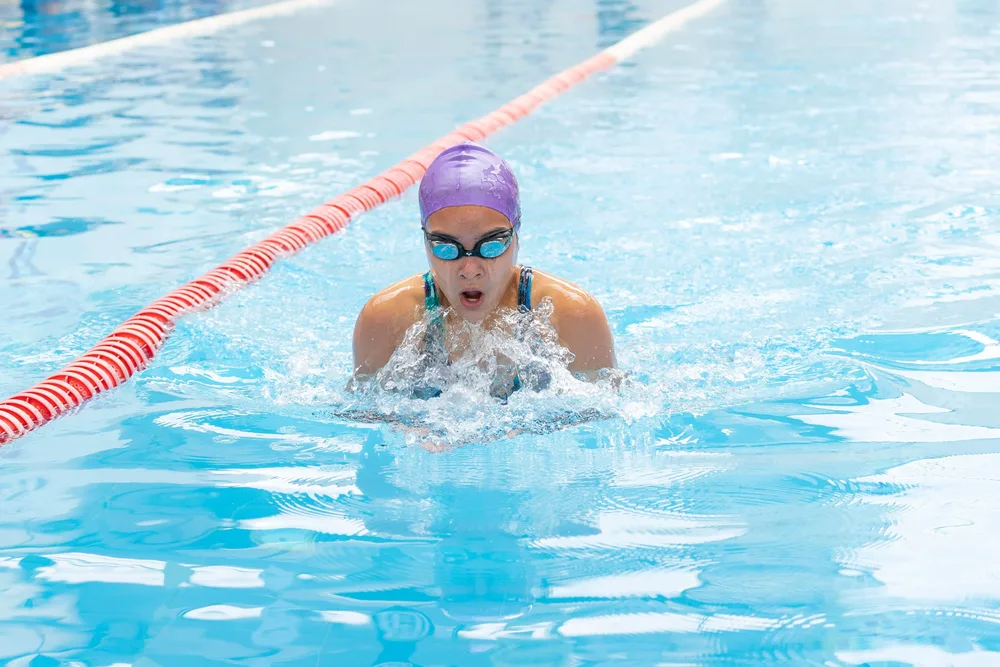
At some point in every club swimmer’s journey, a coach or another parent says the words “county times” — and the sport suddenly acquires a scoreboard. County qualifying times are the entry standards for the county championships, and for most age-group swimmers in Hertfordshire they are the first big external goal of a swimming life. This article explains how they work, where to find them, and — just as usefully — how to read the gap between your child’s current times and the standard without either panicking or dismissing it.
What a qualifying time actually is
A qualifying time (you will also hear “QT”) is simply a cut-off: swim this event, in this age group, faster than this time, at a meet that counts, and you may enter the county championships. Every event has its own standard — 50m freestyle has one, 200m breaststroke another — and the standards are set so that the championships are full but not overflowing.
Two details catch parents out. First, qualifying times are set separately for boys and girls and for each age group, so your child is only ever compared against the right cohort. Second, Hertfordshire publishes two standards for every event: the qualifying time and a slightly softer consideration time — swimmers with a consideration time are ranked and accepted in order until the event is full, rather than guaranteed entry.
One thing this article deliberately does not include is the times themselves. They are published and updated by the county, they change every season, and an out-of-date table is worse than no table. For the real numbers, go straight to the Swim England Hertfordshire swimming competitions page, where the county publishes the current season’s qualifying and consideration times document.
How the age groups work
County championships are organised by age group — typically single years through the age-group stage (10, 11, 12 and so on) and broader bands for older swimmers. The crucial detail is the age-on date: your child’s age for the championships is not necessarily their age today, but their age on a reference date set in the entry conditions.
This matters more than it first appears. A swimmer with a late-year birthday can find themselves “ageing up” into a tougher standard between achieving a time and the championships taking place. Before you set your heart on a target, check which age group your child will actually compete in — your club’s records officer or head coach will know immediately.
Where your child’s times live
Here is the most useful thing a swim parent can learn to do in five minutes: look up your child’s official times. Every swim recorded at a licensed meet in Britain is logged in the British Swimming rankings database, and it is public. Search by your child’s name (or their membership number, which is on their club registration), and you will find every licensed swim they have ever recorded: the event, the time, the meet, and whether it was long course (50m pool) or short course (25m pool).
That long course / short course distinction matters. Times set in 25m pools and 50m pools are listed separately, because turns make short-course swims faster. Check whether the county championships — and therefore the qualifying times — are long course or short course, and compare like with like. Conversion tables exist, but the entry conditions will tell you which converted times, if any, are accepted.
Train with a specialist coach
One-to-one and squad coaching for triathletes, competitive swimmers and adult improvers across Hertfordshire and North London. Places are limited — check availability for your goal.
Check coaching availability →Reading the gap like a coach
Suppose the qualifying time is 1:14.50 for 100m breaststroke and your child’s best is 1:17.80. Is that close? Here is the frame we use.
Divide the gap by the lengths. A 3.3-second gap over four lengths is about 0.8 seconds per length. As a rough rule, anything under half a second per length is within reach inside a season for a developing swimmer; a second or more per length means the target is probably next season’s, and that is fine.
Check the trend, not the snapshot. The rankings database shows every swim, dated. A swimmer who has dropped four seconds in the event over the past year is on a completely different trajectory from one who has been stuck at the same time through three meets — even if today’s PB is identical. (If your child is in the second group, the gap is rarely about effort — read why has my child stopped dropping time? before entering more galas.)
Respect the distance of the event. Two seconds in a 50m sprint is a different sport from two seconds in a 200m swim. Sprint gaps close through technical gains — starts, turns, breakouts, stroke efficiency — because there is simply no room in a 30-second race to out-work a fault. Distance gaps respond to pacing and fitness as well.
Remember the times refresh. Qualifying standards are reviewed each season, and a time that qualified last year may not qualify this year. Chase the current standard, not the balcony folklore.
What to do with all this
If the gap is small, the route is racing: enter the right licensed meets inside the qualifying window and give the swimmer honest chances at the time — the practical mechanics are covered in how to qualify for the county championships.
If the gap is stubborn, the route is usually technical. The fastest way to find several tenths per length is rarely more training volume; it is fixing the specific fault that leaks speed at race pace. That is precisely what our coaching alongside your child’s club is built for — 1-to-1 technical sessions that run alongside your child’s club programme and target the event, and the fault, that stands between them and the time.
For the wider context — squads, meets and the whole ladder — start at our parent’s guide to competitive swimming in Hertfordshire.
Parent FAQs
Where do I find the current Hertfordshire county qualifying times?
Swim England Hertfordshire publishes the official qualifying and consideration times for each season on swimherts.org, alongside the championship dates and entry conditions. Always use the current season’s tables from the official source — times change every year, and out-of-date copies circulate widely.
Do times from any gala count towards county qualification?
No. As a rule, qualifying times must be achieved at licensed meets within the qualifying window set for that season, so they appear in the official British Swimming rankings. Your club will confirm which meets on its calendar count — it plans them with exactly this in mind.
My child is two seconds outside the qualifying time. Is that close?
It depends on the event. Two seconds in a 200m event is a small gap that a good training block can close; two seconds in a 50m sprint is enormous. Divide the gap by the number of lengths in the race — a deficit under half a second per length is usually within reach with targeted technical work.
What is the difference between a qualifying time and a consideration time?
A qualifying time guarantees entry if achieved within the window. Some championships also use consideration or entry times, where swimmers at or near the standard are ranked and accepted in order until the event is full. Check the current entry conditions on swimherts.org, as the exact mechanism can change from season to season.